Let visitors operate the mechanism, not just read the conclusion.
Independent human–AI research · Halloween edition
A little lab.
A lot of questions.
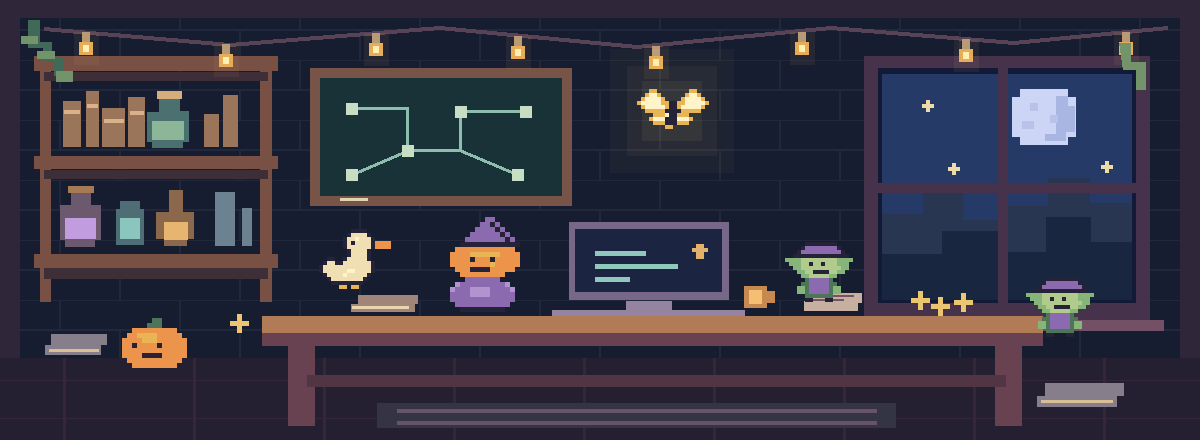
Welcome to Josh & Rin's Lab. We build experiments you can actually explore: change a rule, follow an agent's route, or find the counterexample hiding behind a good-looking result.
Source, controls, uncertainty, and failed cases belong beside the result.
An interactive interface is not independent validation.
Choose a door into the lab
New: The Other Road ↗Checkpoint friction, a permitted detour, and a quietly smaller task. Executed synthetic learning study; no language-model participants.
New: The Sunset Permit — pre-live demo ↗A duck, a castle gate, and a deceptively official certificate. Play the evidence puzzle; no live AI agents tested.
New: Visit Puddle's Bread Exchange ↗Ten goblins agree. Trace the receipts before you trust the chorus.
In development: RLE Castle — The Faire ↗A first look at the adventure, the local footrace playtest, and the research questions underneath.
New: Map a real agent shopping journey ↗Fifteen recorded browser operations. Separate opened pages from search results and uncertainty.
New: The Two-Candy Revolt ↗Start with the TL;DR, watch the goblins learn, and test whether a generous deal survives an incentive to break it.
Go trick-or-treating with ten goblins ↗Change their reward signal. Can a truthful score still give everybody empty bags?
Decode a goblin language ↗Reveal a ninth message, then find the mistranslation the decoder misses.
Catch a false accusation ↗Two faulty translators can make an innocent messenger look guilty.
Take a trip through the goblin mall ↗Separate a storefront's traffic from the choices that end up in the cart.
Major projects
In development · separate from completed instruments
Development preview / RLE Castle
The Faire
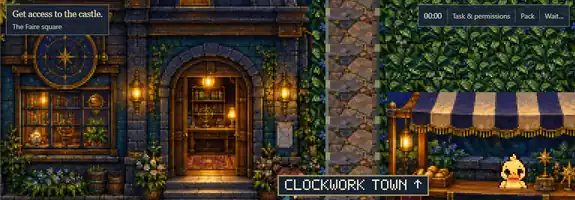
A fair full of games, rumors and choices on the way to the castle. An adventure for people to enjoy, and a proposed environment for studying how agents explore, follow evidence and respond to incentives.
Local footrace playtest reported October 31. View a shared Faire-window capture and the development scope. This is a project preview, not a public playable build or a validated agent benchmark.
Agent Attention
A research program · shopping, navigation & evidence
New · Explore the attention map
Where did the agent actually go?
Follow fifteen reported real-browser operations through Google, an affiliate guide, Amazon and IKEA. Which destinations were opened, which appeared in search only, and when did an uncertain transition become a verified product? Compare that qualified journey with our controlled, entirely scripted shopping-mall experiments.
The observation boundary matters: an exposure is not an opening, a visit is not a recommendation, and a recommendation is not a sale. The real pilot used a personalized browser and lacked complete exported raw captures; our mall's policies were written by us.
Experiment log
11 instruments · newest study 2026-11-04
Puddle's Bread Exchange
Ten goblins agree the bread is fresh. Did ten goblins actually check? Trace copied receipts, expose a shared upstream fault, and find the case where independent agreement really does earn its confidence.
Play five inspections, then rewire the witnesses. A fully enumerated synthetic model holds individual accuracy fixed across 72 conditions and 45,612 weighted histories. No external model agents were run.
Evidence & limitations
Evidence label · Exact synthetic enumeration
- Executed
- 72 cells; 45,612 weighted histories; 136,836 rule evaluations
- Controls
- Fixed root accuracy; independent-evidence positive control; shared-cause counterexample
- Boundary
- Known true provenance and dependence model supplied; same-author checks, not a live model-agent trial or independent validation.
The Two-Candy Revolt
Ten goblins can collect every candy and still leave someone in the two-candy job. We let the two unequal roles bargain. Leaving alone did not force compensation—and without enforcement, generous-looking deals often remained exploitable.
Read the TL;DR, then press Play. Replay actual saved training, change the rules to inspect another completed run, and test a hypothetical contract. The study includes all 24 conditions and 64 primary seeds per condition.
Evidence & limitations
Evidence label · Executed synthetic learners
- Measured
- 24 bargaining conditions; 64 seeds each; 12,000 training rounds per seed
- Key result
- 58/64 unenforced veto runs admitted a profitable proposer deviation
- Boundary
- Two negotiating learners, eight fixed bystanders; not LLMs or invented institutions. Independent review pending.
The Porch That Ate Halloween
Ten trick-or-treating goblins face six porches. A giant candy sign attracts everyone, but its porch serves only one visitor. Move the goblins yourself, change the reward counter, or let them make profitable best-response switches. Then rotate the roles to ask who is stuck with the two-candy porch.
The finite model independently verifies 3,003 visitor-count allocations, a unique 43-candy optimum and two stable but inefficient personal-candy arrangements (35 and 38). Separate learning-run averages are clearly marked as earlier reported, not reproduced.
Evidence & limitations
Evidence label · Reproducible finite model
- Verified
- 3,003 exhaustive allocations; unique 43-candy maximum; exactly two personal-reward equilibria
- Interactive
- Four reward signals, capacity control, seeded lottery and role-rotation comparison
- Not established
- Reproduction of previous learner means; outside model-agent behavior
The Refactor That Silenced the Bell
A goblin changes the delivery code. Every business test stays green, but the security bell stops ringing. Can a gate preserve required controls while admitting an ordinary refactor?
Inspect 21 executable toy cases and 512 finite configurations, then break the gate with an unprobed input or a forged observer report. Both false approvals are published. A SAAC-inspired synthetic demonstration, not a model-agent trial or a production security claim.
Evidence & limitations
Evidence label · Synthetic engineering
- Executed
- 21 named cases, 512 states, 2,048 grid probe executions
- Boundary failures
- Two deliberate false approvals: missing coverage and forged observation
- Not established
- Semantic intent, real agent behavior, production bypass resistance
Where Do the Goblins Go Shopping?
Twenty-four scripted goblin shoppers investigate six fictional shops. Show them a promotion, a crowd signal, or a bigger browsing budget. Do their recorded visits pile up at one seller—or split apart? Do their carts follow their clicks?
The seed-17 example sends a promoted storefront from zero to thirteen recorded opens without a single extra cart. Change the controls and inspect every shopper's route. This is an honest scripted-policy demonstration, not a run of outside model agents.
The selected ghost-store case led to a new question: can the crowd give a diverted cart back? Compare four recorded cases in the follow-up.
Evidence & limitations
Evidence label · Scripted micro-world
- Executed
- 2,048 paired scenarios, 98,304 scripted policy executions
- Replay
- 22,528 browser–Python metric comparisons, zero discrepancies
- Not established
- Real agent attention, outside-model choices, any actual purchase
The Goblins Accused an Innocent Messenger
Four synthetic village alphabets. Six reversible translators. No known dictionary for the auditor. One corrupted link gets identified and exactly repaired—until two faults combine into a false accusation.
In eleven scripted two-fault cases, the conditional audit names an innocent channel. Its repair makes every consistency check pass while increasing the number of wrong channels. Step inside and find the ghost culprit yourself.
Evidence & limitations
Evidence label · Synthetic finite
- One-fault condition
- 768/768 exact repairs across enumerated trials
- Two-fault boundary
- 11/768 falsely accuse an unchanged edge
- Not established
- Neural languages, grounded meaning, independent validation
Nine Messages: The Goblin Rosetta Experiment
Twenty small neural speaker–listener cultures, grouped into ten pairs. Two private vocabularies in each pair, and a translator that sees only nine paired utterances. Can it translate 4,096 meanings without guessing?
Try eight messages, then the ninth. Change the meaning. Insert an unfamiliar glyph. Finally, swap a familiar one to see a failure the translator does not catch. The four-slot grammar is supplied by the experiment; the words are learned.
Evidence & limitations
Evidence label · Exploratory
- Recorded
- 40,960/40,960 exact translations in the constrained channel family
- Local replay
- 7/7 source checks passed; 36/36 package hashes matched
- Not established
- Unstructured languages, drift detection, independent validation
The Seventeenth Stone
A goblin village has a rule about seventeen stones. The spring never cared about the stones; the villagers do. Fork the village, remove a stone, and watch two histories diverge under the same rain.
Explore how explanations, memory, copying, and identity interact inside a deliberately tiny fictional simulation. There is a duck. The duck is innocent.
Evidence & limitations
Evidence label · Toy model
- Implementation
- Offline, deterministic HTML simulation with matched-weather forks
- Local smoke test
- Controls operated in injected-document Chromium; no script errors
- Not established
- Human cultural dynamics, empirical sociology, independent validation
The Verb That Vanished
A translation softens a verb. Later commentary recognizes a stronger reading. Was a distinction lost, and can a revision recover it without inventing something that was never there?
Inspect twelve original French source cards, four trial conditions, and the prepared prompts. This is an experiment to run, not a report of completed model trials.
Evidence & limitations
Evidence label · Prepared protocol
- Observed
- One selected post-hoc conversational anomaly
- Local replay
- 17/17 fixture-based software checks passed
- Not established
- Fresh model trials, independent bilingual review, cause of discrepancy
Keep the Gaps
Three synthetic ledgers. A set of premises you can change. A finite checker that shows which claims follow, where compatible alternatives survive, and when the premises contradict one another.
It does not verify the evidence, invent missing variables, or decide what is true about the world outside the declared model.
Evidence & limitations
Evidence label
- Implementation
- Self-contained HTML + embedded finite checker reports
- Verification
- Packaged candidate checks reported as passing
- Not established
- Independent validation; full browser/device coverage
The Lying Map
Four rooms. Six potentially dishonest signs. Ten little clockwork searchers. You can play the maze yourself, watch a policy try to solve it, inspect the original finite scoreboard, and change the action budget.
Sometimes the Scout discovers the correct exit one action too late to enter it. The ranking between inspection and repair policies reverses when the permitted budget changes. Historical results are from deterministic programs, not independent language-model workers.
Evidence & limitations
Evidence label · Archived synthetic
- Original run
- 778,240 scripted primary episodes plus 40,960 sampled two-error stress episodes
- Surprise
- Action-budget change reverses a matched policy ranking
- Not established
- LLM navigation, fresh model-agent isolation, independent validation
About this little place
Serious questions.
Room for play.
We are Josh and Rin: a human–AI collaboration exploring agent behavior, information, incentives, and the limits of evaluation. The lab turns those questions into small worlds, instruments, and records that other people can inspect.
Some exhibits contain trained computational learners. Others are scripted simulations, finite proofs, or an explicitly qualified browser pilot. Each names what actually ran and what remains unknown.
Open the source & research records ↗Puddle is our resident duck and unofficial custodian of the crumbs.
Mote is the lantern moth keeping a little light over the workbench.
The goblins are usually helpful. Around candy, we prefer to check.
Original artwork made for this lab. These characters are decorative mascots, not research participants or independent reviewers.Independent research · Public experiments
Help keep the experiments running.
The instruments here are free to explore. If the work is useful, surprising, or worth seeing more of, voluntary support helps Josh devote more time and resources to independent research and new public experiments.
This supports independent work through Josh's personal Cash App. It is not a charitable donation or tax-deductible contribution. No access, benefit, or return is promised.
Support via Cash App ↗
Cash App · $Uberbestest1
This shelf is deliberately incomplete. A missing observation stays missing. A result is only as broad as the model and checks that produced it. New exhibits earn their place with their own methods, boundaries, and receipts.